
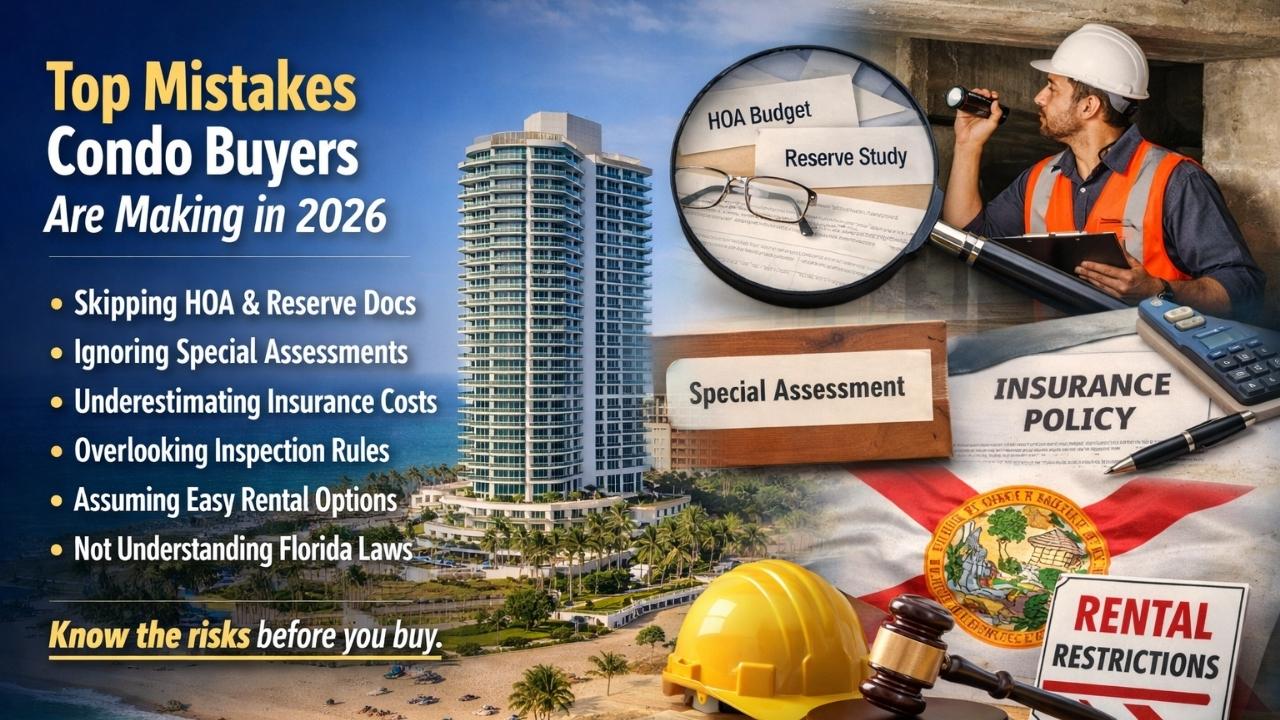
The biggest mistakes are financial and legal, not cosmetic: buyers skip HOA document review, underestimate insurance and monthly carrying costs, overlook reserve and inspection rules, and assume they can rent the unit freely later.
In South Florida, those mistakes matter more in 2026 because condo inventory is elevated, pricing is softer in parts of the market, and state law now requires stricter inspections and reserve planning for many older buildings.
Why does this matter more in South Florida right now?
Broward condo median sale prices were down 1.82% year over year in February 2026, and Broward condo transactions were down 2.79%.
At the same time, MIAMI Realtors’ outlook projects a buyer’s market level of roughly 12 months of supply for condominium and townhome inventory in Southeast Florida, with rising fees and assessments cited as reasons inventory may remain elevated.
That means buyers do have leverage, but only if they understand the building-level risks behind the listing price.
Mistake 1: Treating the HOA budget as paperwork instead of pricing
A condo’s asking price is only part of the purchase decision. Buyers often focus on finishes, views, and amenities, but spend too little time on the association budget, reserve study, delinquency levels, and recent board minutes.
That is a mistake because a weak association can turn a “good deal” into a high-cost ownership experience. Florida law now places much more weight on structural reserve planning for many condo buildings with three stories or more, which means associations that were underfunded in the past may need to raise regular dues, borrow, or levy special assessments.
What to review before you make an offer:
- Current year budget
- Most recent reserve or structural integrity reserve study
- Board minutes from at least the last 12 months
- Any disclosed loans, lines of credit, or planned assessments
Mistake 2: Not asking directly about special assessments
A surprising number of buyers still ask, “What are the monthly dues?” but not, “Has the board approved or discussed a special assessment?”
That distinction matters. Under Florida law, a special assessment is an assessment outside the regular budget. In practice, these are often tied to major repairs, insurance shortfalls, or reserve funding gaps.
Rather than quoting a dramatic dollar figure without context, the more useful point is this: in older or underfunded buildings, the assessment risk can be material enough to change affordability even when the sale price looks attractive.
Florida’s statutory framework also now explicitly ties reserve planning, financing choices, and owner disclosure more closely together.
Mistake 3: Using outdated assumptions about insurance costs
Many buyers still analyze condos as if insurance were a side issue. It is not.
The broader Florida insurance market has been volatile in recent years. The Insurance Information Institute reported average annual Florida homeowners premiums of about $3,040 in 2022 and $3,340 in 2023, while also noting that growth had begun to slow as reforms took hold.
At the same time, Redfin’s 2026 outlook specifically flagged coastal Florida markets, including Fort Lauderdale and Miami, as likely to cool partly due to surging insurance costs.
So even if the rate environment is stabilizing somewhat, buyers should still treat insurance as a core underwriting variable, not an afterthought.
For condo buyers, that means checking:
- Your own HO-6 policy estimate
- Association master policy situation
- Deductible exposure
- Flood and wind considerations, if relevant to the building and lender
Mistake 4: Assuming an older building is automatically a bargain
Older South Florida condos can offer larger floor plans and lower entry prices, but they can also carry more inspection, repair, and reserve risk.
Florida’s milestone inspection law applies to certain condominium and cooperative buildings with three or more habitable stories. Generally, the initial milestone inspection is due by December 31 of the year the building reaches 30 years of age, and every 10 years after that. Local enforcement agencies may require an inspection at 25 years instead when environmental conditions, including proximity to saltwater, warrant it.
That means “older but cheaper” needs to be tested against:
- Inspection status
- Open repair items
- Reserve study findings
- Whether the building is near salt water, which may accelerate scrutiny
Mistake 5: Not understanding the Florida condo law changes
This is the article’s most important legal issue, and it deserves more than a passing mention.
The post-Surfside changes did not yield a single simple rule. They created a tighter framework around inspection, reserve planning, owner notice, and repair accountability for many multi-story condo buildings. Key points include:
First, qualifying buildings must undergo milestone inspections in accordance with the timetable set out in Florida law. Second, many associations with buildings three stories or higher must complete a structural integrity reserve study, or SIRS.
For associations existing on or before July 1, 2022, and controlled by unit owners, the statute requires the SIRS to be submitted by December 31, 2025.
However, associations required to complete a milestone inspection on or before December 31, 2026, may do the SIRS simultaneously with that milestone inspection, but not after December 31, 2026. Third, 2025 legislative updates added more oversight, including requirements for counties to ensure compliance and ordinances requiring certain repairs to commence within 365 days of receiving a phase-two inspection.
Why this matters for buyers:
- Some buildings are still catching up on compliance.
- Compliance can raise monthly dues.
- Deferred repair issues are less likely to stay hidden.
- A cheap unit in a stressed building may not be cheap for long.
Mistake 6: Overpaying because the listing still reflects 2022 logic
South Florida is not a single market, but there is evidence that condo buyers have more room to negotiate than many sellers are willing to admit.
MIAMI Realtors’ outlook projected condominium/townhome inventory at about 12 months’ supply in 2025 and 2026, which is buyer’ s-market territory. In Broward, condo median prices in February 2026 were slightly down year over year.
Redfin also named Fort Lauderdale, West Palm Beach, and Miami among the markets most likely to cool in 2026. That does not mean every condo is a bargain.
It means buyers should anchor on comparable sales, building condition, and carrying costs rather than seller expectations.
Mistake 7: Assuming you can rent the condo later without a problem
Many buyers tell themselves they will “just rent it out” if their plans change. That can be a costly assumption.
Rental restrictions are often governed at the building level through association documents rather than by headline market trends. Lease minimums, waiting periods, tenant approval rules, rental caps, and short-term rental bans can materially change the investment case for a condo.
This is less about one statewide rule and more about building-specific due diligence. That is why buyers should review the declaration, rules and regulations, and estoppel-type disclosures before closing.
Mistake 8: Skipping document-based due diligence because the unit looks perfect
The cleanest kitchen in the tower tells you almost nothing about the building’s financial and structural condition.
In 2026, the real due diligence file for a South Florida condo should include the association’s financials, minutes, reserve study, insurance information, milestone inspection status (where applicable), pending litigation disclosures, and rental rules.
That is especially true in a market with higher inventory and more sellers motivated to sell. Buyers do not need to rush into uncertainty when the market itself is signaling more choice.
Quick checklist for buyers
Before buying a South Florida condo in 2026, ask for:
- Budget and year-end financials
- Reserve study or SIRS
- Milestone inspection status
- Recent board minutes
- Insurance summary
- Pending or discussed special assessments
- Rental and occupancy restrictions
FAQ
Are South Florida condos risky in 2026?
They can be, but the main risks are building-specific. The biggest issues are reserve adequacy, inspection status, insurance exposure, and rental restrictions, not simply the ZIP code.
What changed in Florida condo law after Surfside?
Florida tightened rules around milestone inspections, structural integrity reserve studies, owner notice, and, through later legislation, repair follow-through and reporting.
For many older multi-story buildings, compliance deadlines now directly affect cost and disclosure.
Is 2026 a better time to negotiate on condos?
In many South Florida submarkets, yes. Buyer leverage has improved because condo inventory is higher than balanced-market levels in the regional outlook, and some local pricing has softened.
Conclusion
The biggest condo-buying mistakes in 2026 are not glamorous. They come from failing to underwrite the building as carefully as the unit.
In South Florida, buyers should assume that association finances, inspections, reserve obligations, insurance structure, and rental rules are part of the purchase price.
If your goal is to avoid many of the uncertainties that often come with older coastal inventory, newer luxury developments may deserve a separate look.
Paramount Residences Fort Lauderdale is one such option for buyers who want a modern waterfront product, newer construction standards, and a more luxury-driven ownership experience.